
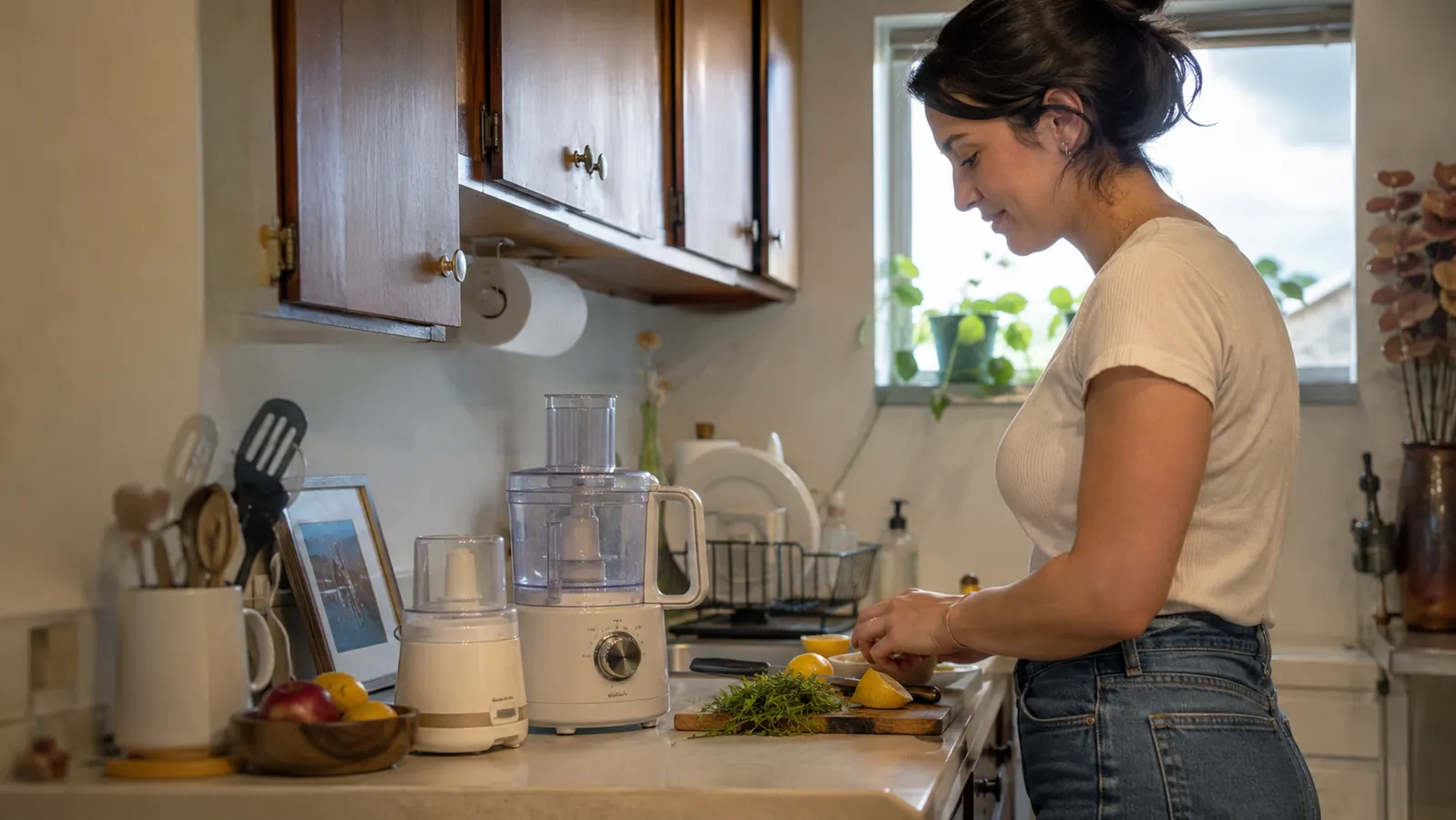
If your counter gives you maybe two feet of clear space and most nights you're only chopping onion, garlic, and a handful of herbs, get the Hamilton Beach 3 Cup Electric Vegetable Chopper. It costs less than a third of what the Cuisinart Mini-Prep Plus runs at today's price, and it takes up close to half the footprint. The Cuisinart earns its extra money back if you regularly cook for more than two people, want a bigger bowl so you're not running a second batch, or need the reversible blade's grinding edge for nuts and hard cheese. That's the short version. The long version is six weeks of running both on my own seven-foot galley counter, and what actually separated them once the novelty wore off.
I bought the Hamilton Beach first, back when I was outfitting a one-bedroom apartment with a single run of counter and no room to experiment with a bigger machine. I used it almost nightly for four months before a friend let me borrow her Cuisinart Mini-Prep Plus for six weeks to see whether the extra twenty-some dollars actually bought me something I'd use. Both sat in the same spot on my counter, next to the same cutting board, so this comparison is measured against my own fourteen-inch upper cabinet clearance and my own real dinners, not a spec sheet in a store aisle. I also wanted to know, honestly, whether I'd been talking myself out of a genuinely better machine just to save twenty dollars, or whether the smaller one had actually earned its spot fair and square.
| Spec | Hamilton Beach 3 Cup Chopper | Cuisinart Mini-Prep Plus |
|---|---|---|
| Footprint (W x D x H) | 4.5 in x 4.5 in x 8.7 in tall | 6.5 in x 7 in x 8.75 in tall |
| Weight | about 2.1 lbs | about 3.3 lbs |
| Bowl capacity | 3 cups | 4 cups (about 3 cups of ingredients before it fights back) |
| Blade | single fixed stainless S-blade | reversible stainless blade, one edge for chopping, one for grinding |
| Controls | press-to-run lid, no dial or speed settings | two-speed dial for chop and grind, plus a separate pulse button |
| Cleanup | bowl, lid, and blade are all dishwasher-safe | bowl and blade dishwasher-safe, reversible blade edge needs more careful handwashing |
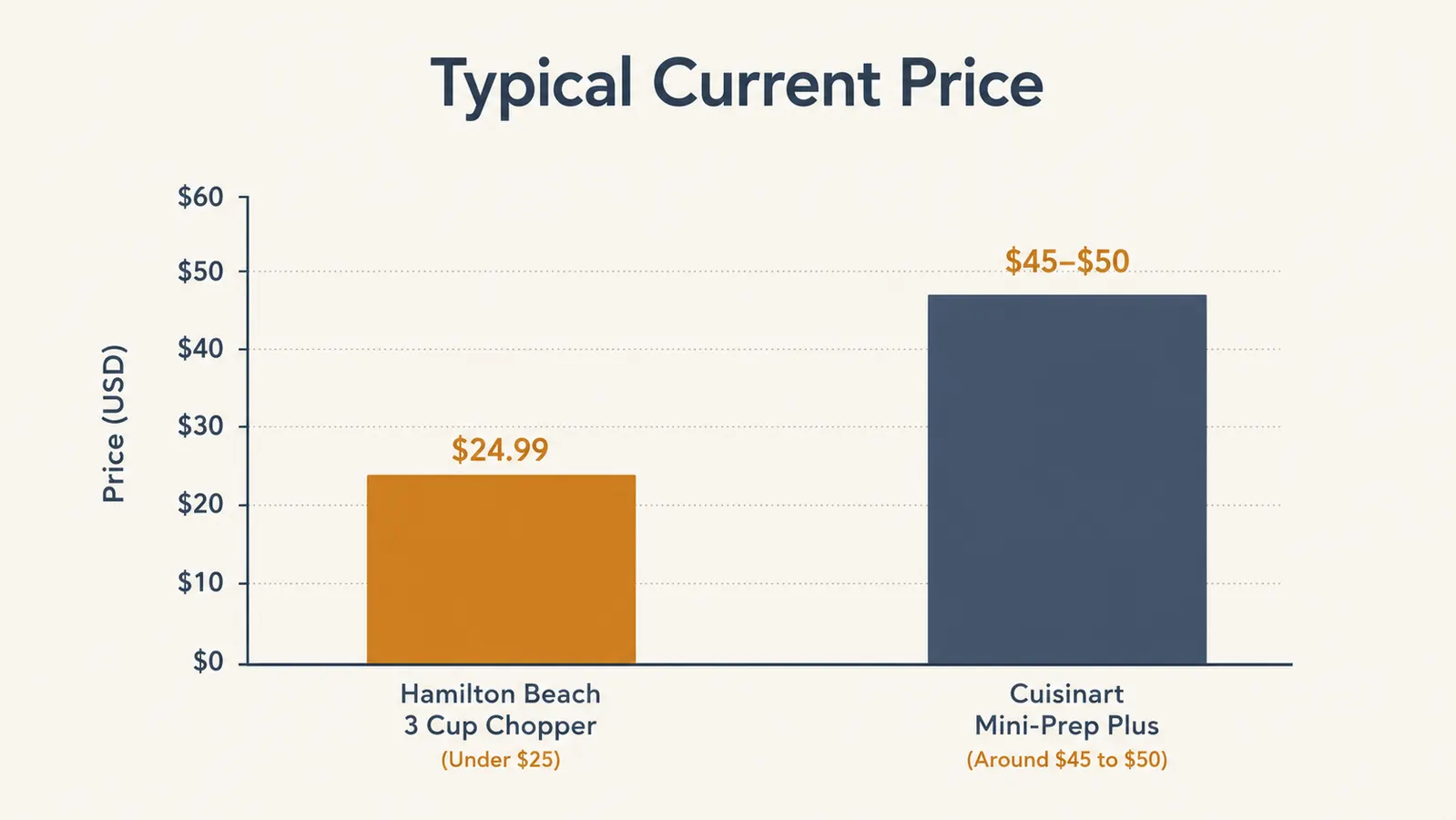
| Typical current price | very affordable | budget to mid-range |
| Best for | onion, garlic, herbs, and salsa in a single-run tiny kitchen | bigger batches, tougher ingredients, and anyone who wants real speed control |
Those numbers came from chopping the same handful of things in both machines over six weeks: a full onion, three cloves of garlic, a cup of walnuts for muffins, and a wedge of parmesan I tried grinding on a whim. I used a kitchen timer instead of trusting either machine's feel, because a press-to-run lid and a speed dial measure effort completely differently. The Hamilton Beach diced the onion evenly in six or seven short presses, close to fifteen seconds total. The Cuisinart took about the same time on its low speed setting, but the bowl held the entire onion without crowding, where the Hamilton Beach's smaller bowl filled almost to the line with just one.
I also paid attention to how each one actually behaved on my counter, not just what the box promised. The Hamilton Beach's 4.5-inch square base means it clears my fourteen-inch upper cabinet with room to spare, and at just over two pounds I keep it in the cabinet next to my stove and pull it down in about five seconds. The Cuisinart's wider base and taller motor housing meant I left it sitting out on the counter the entire six weeks, since lifting it down and back up every night felt like more trouble than it was worth for a machine that size. That single difference, out versus away, ended up mattering more to my day-to-day experience than either machine's actual chopping performance.
The reversible blade is the real feature gap between the two. Flipped one way, the Cuisinart's blade chops and minces about as well as the Hamilton Beach's single blade. Flipped the other way, the grinding edge handled the parmesan wedge and a cup of walnuts noticeably better, breaking both down into a fine, even texture instead of the chunkier result I get from the Hamilton Beach on the same ingredients. If nut butter, ground parmesan, or breadcrumbs are a regular part of your cooking, that second edge is doing real work the cheaper machine simply can't.
Cleanup told its own small story too. The Hamilton Beach's bowl, lid, and blade all go straight into the dishwasher's top rack, no second thoughts, and I've run it through fifty or sixty times without any of the pieces warping or clouding badly. The Cuisinart's bowl and blade are also dishwasher-safe, but I got in the habit of handwashing the reversible blade anyway, since I didn't love the idea of the second, grinding edge banging against other silverware in the rack over months of use. That's a small extra step, but on a night when I'm already tired, small extra steps are exactly the kind of thing that decides whether an appliance gets used or gets skipped.
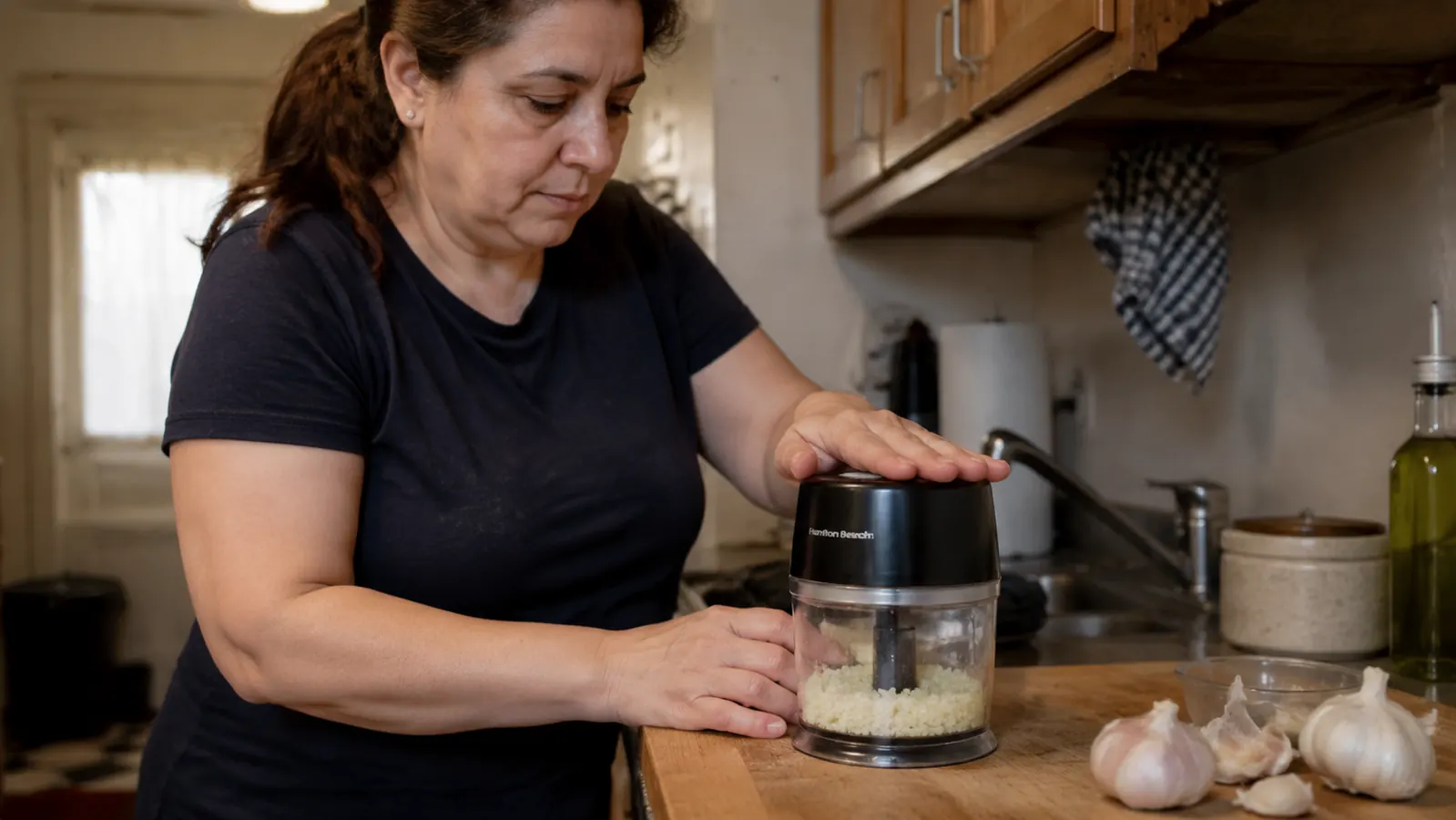
Where the Hamilton Beach Wins
Price is the obvious one, but it's not the only one. At under twenty-five dollars, the Hamilton Beach costs less than half of what the Cuisinart runs at today's price, and for the jobs I actually do most nights, onion, garlic, fresh herbs, a quick batch of salsa, it does the job just as fast. I never once felt like I was missing something during the four months I used it before the Cuisinart even showed up in my kitchen. If you're outfitting a first apartment, a dorm, or a small rental kitchen where this isn't going to be your primary food processor, there's no real reason to spend the extra money.
It's also the far easier machine to actually store. At 2.1 pounds and a 4.5-inch square base, I lift it out of the cabinet and back in without thinking about it, which is the whole reason it gets used almost daily instead of sitting untouched. The Cuisinart's wider base and extra pound and change don't sound like much on paper, but after two weeks of lifting it down and setting it back, I gave up and just left it on the counter, which is exactly the kind of permanent footprint creep I try to avoid in a kitchen with one run of space to give.
There's also less to think about while you're using it. No dial to set, no speed to pick, no wrong choice to make while you're hungry and just want minced garlic. Lock the lid, press down, let go when it looks right. The Cuisinart's two speeds and pulse button are genuinely useful once you know what each one does, but that's a learning curve the Hamilton Beach simply doesn't ask you to climb, and on a weeknight that difference matters more than it sounds like it should.
Where the Cuisinart Wins
Capacity is the real tradeoff, and it's a legitimate one if you're cooking for more than one or two people. The Cuisinart's 4-cup bowl held a full onion with room left over, where the Hamilton Beach's 3-cup bowl fills almost to the top with the same onion and needs a second batch for anything bigger. If you're regularly making a big pot of chili or a large batch of salsa, that extra headroom saves the forty seconds of dumping and reloading that adds up across a week of real cooking.
The reversible blade is the other genuine advantage. Being able to flip the blade to a grinding edge for parmesan, hard nuts, or breadcrumbs means the Cuisinart can do a wider range of jobs than a single fixed blade, closer to what a small food processor is actually supposed to do rather than a chopper that only chops. The two-speed dial also gives more control than a press-and-hope lid, which matters if you're working with something delicate like fresh basil that turns to mush in a few extra seconds under the wrong setting.
It also just feels like a more finished appliance once it's out on the counter, which matters if yours is visible from a living room the way mine is. The dial and pulse button give it a more considered look next to a stand mixer or a coffee setup than a plain lid-and-base design does. That's a cosmetic point more than a functional one, but for a kitchen where every appliance is on permanent display instead of tucked in a pantry, it's not nothing, and it's part of why my friend never once talked about putting hers back in a cabinet.
The one that earns its spot without the extra bowl you don't need
For onion, garlic, herbs, and salsa on a genuinely tight counter, the cheaper chopper gets it done in seconds. See today's price on the Hamilton Beach 3 Cup Chopper.
Amazon Check Today's Price on Amazon →I lifted the Hamilton Beach down from my cabinet every single night for four months. I never once did that with the Cuisinart once it landed on my counter.

Who Should Buy Which
If your kitchen has one run of counter and most nights this appliance is handling onion, garlic, fresh herbs, and the occasional batch of salsa, the Hamilton Beach is the more honest buy. It's lighter, it's less than half the price, and in four months of near-daily use before the Cuisinart ever entered the picture, I never felt like I was working around a limitation I actually cared about. It's also the easier machine to commit to in a first apartment or a rental where the kitchen itself might change in a year.
If you're cooking for a family of four or more, want to grind parmesan or nuts regularly, or you'd rather have real speed control than a single press-to-run lid, the Cuisinart's bigger bowl and reversible blade are worth the higher price. Just weigh that against the extra pound and the wider base you'll either be lifting on and off the counter daily, or more realistically, the counter space it'll quietly claim once you stop lifting it at all, which is what happened in my own kitchen inside the first two weeks of borrowing one.
There's also a middle case worth naming. If you're not sure yet how often you'll actually reach for a chopper, start with the cheaper one. I've watched people buy the bigger, pricier machine first, use it twice a month, and quietly resent the space it holds. Buying the Hamilton Beach first and upgrading later, once you actually know your own chopping habits, costs less overall than guessing wrong on the bigger machine up front, and you'll know within a month which kind of cook you actually are.
Measure your cabinet, then decide
Four and a half inches square is the number that matters if your kitchen only gives you one run of counter. Check today's price on the Hamilton Beach 3 Cup Chopper and see if it fits yours.
Amazon Check Today's Price on Amazon →