
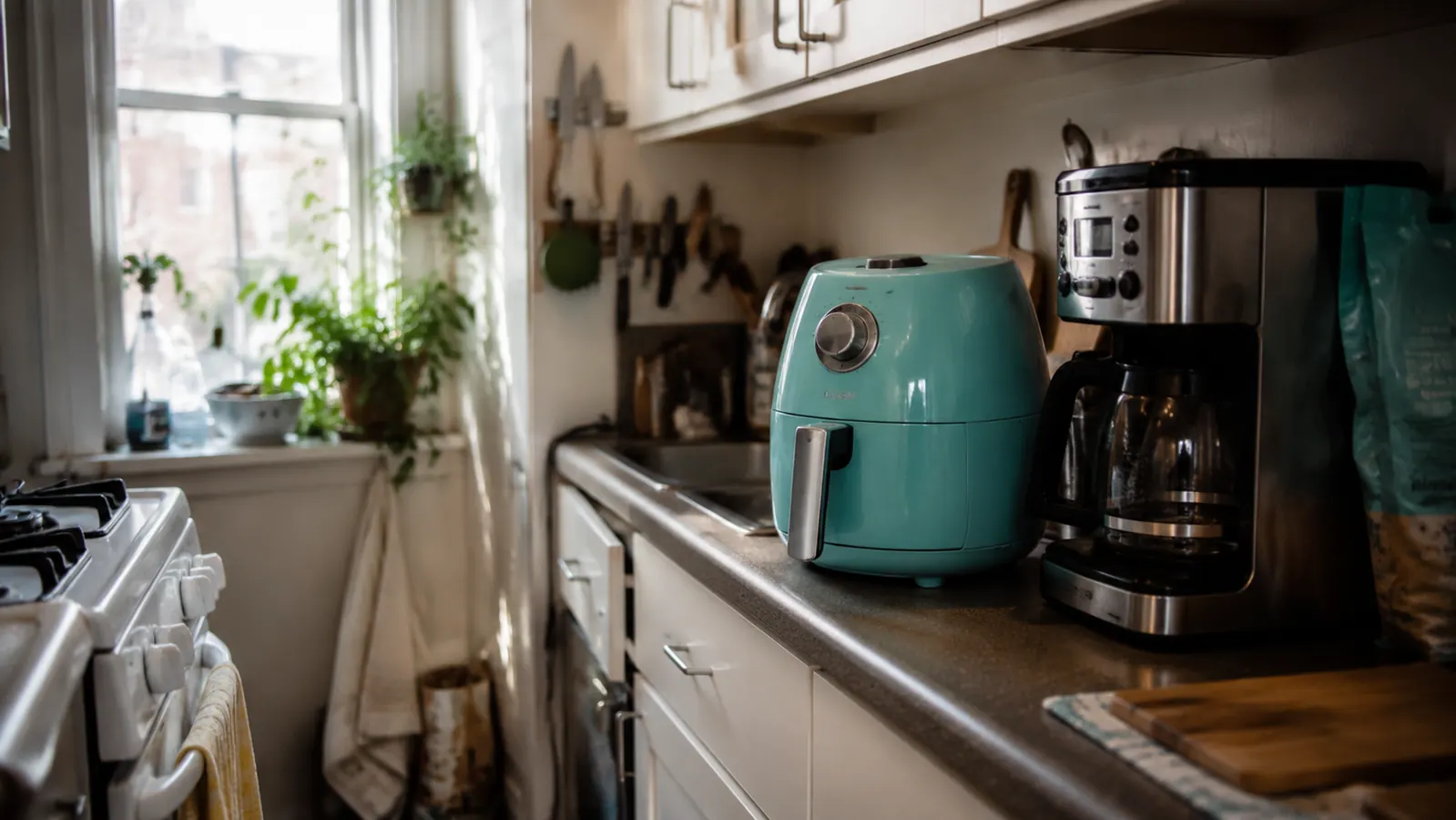
I have eleven inches of open counter in my kitchen. I've measured it more than once, mostly out of spite, because every appliance review online seems to assume you're working with three feet of granite and a pantry the size of a closet. I'm not. My kitchen is one wall, one window, and a stretch of laminate between the sink and the stove that I have to defend like it's a parking spot. Six months ago I bought the DASH Tasti-Crisp 2.6 Quart Air Fryer to replace a toaster oven that had taken up permanent residence there and never earned it back.
The short version: it's still on my counter. That alone puts it ahead of the last three appliances I tried in that spot, all of which got demoted to a cabinet within a month. But "still there" isn't the same as "perfect," and I want to walk through what six months of actual weeknight cooking with it looks like, not just the unboxing week when everything feels like a win.
The Quick Verdict
A genuinely small air fryer that earns its counter space in a tight kitchen, with a basket small enough to feel limiting for two people and a nonstick coating that's starting to show its age.
Amazon Check Today's Price →Still deciding if a 2.6-quart basket is big enough for your kitchen?
Check today's price and current availability on Amazon before you commit counter space to it.
Amazon Check Today's Price on Amazon →How I've Used It
I run this air fryer four to five nights a week, mostly for the things that used to mean turning on my full oven for twenty minutes to cook a portion that didn't need a full oven: chicken thighs, frozen fries, reheated pizza, the occasional batch of roasted broccoli when I'm trying to eat like an adult. I cook for one most nights and for two on weekends, which turned out to matter more than I expected.
The basket is 2.6 quarts, which DASH markets honestly as a one-to-two person size. For me alone, it's plenty. Two chicken thighs and a handful of fries fit with room to shake the basket without food falling out the sides. For two people eating the same meal, I've had to run it twice, which adds about twelve minutes to dinner and one extra load into the basket to wash.
I keep it on the counter, not in a cabinet, which was the whole point of buying it. It sits between my coffee maker and the wall, and at 8 inches wide it fits in a spot that a standard 4-quart or larger air fryer simply would not. I checked before I bought it. My old toaster oven was 15 inches wide and it ate that whole stretch of counter by itself.
The controls are two dials, one for temperature and one for time, with a small indicator light that tells me it's running. That sounds like a minor thing to mention, but after six months of daily use I've come to appreciate not having a touchscreen to wipe down every time my hands are greasy from breading chicken. I set it, I walk away, I come back when the timer clicks off. No app, no Bluetooth pairing, no firmware update notification interrupting dinner.

The Footprint, Measured
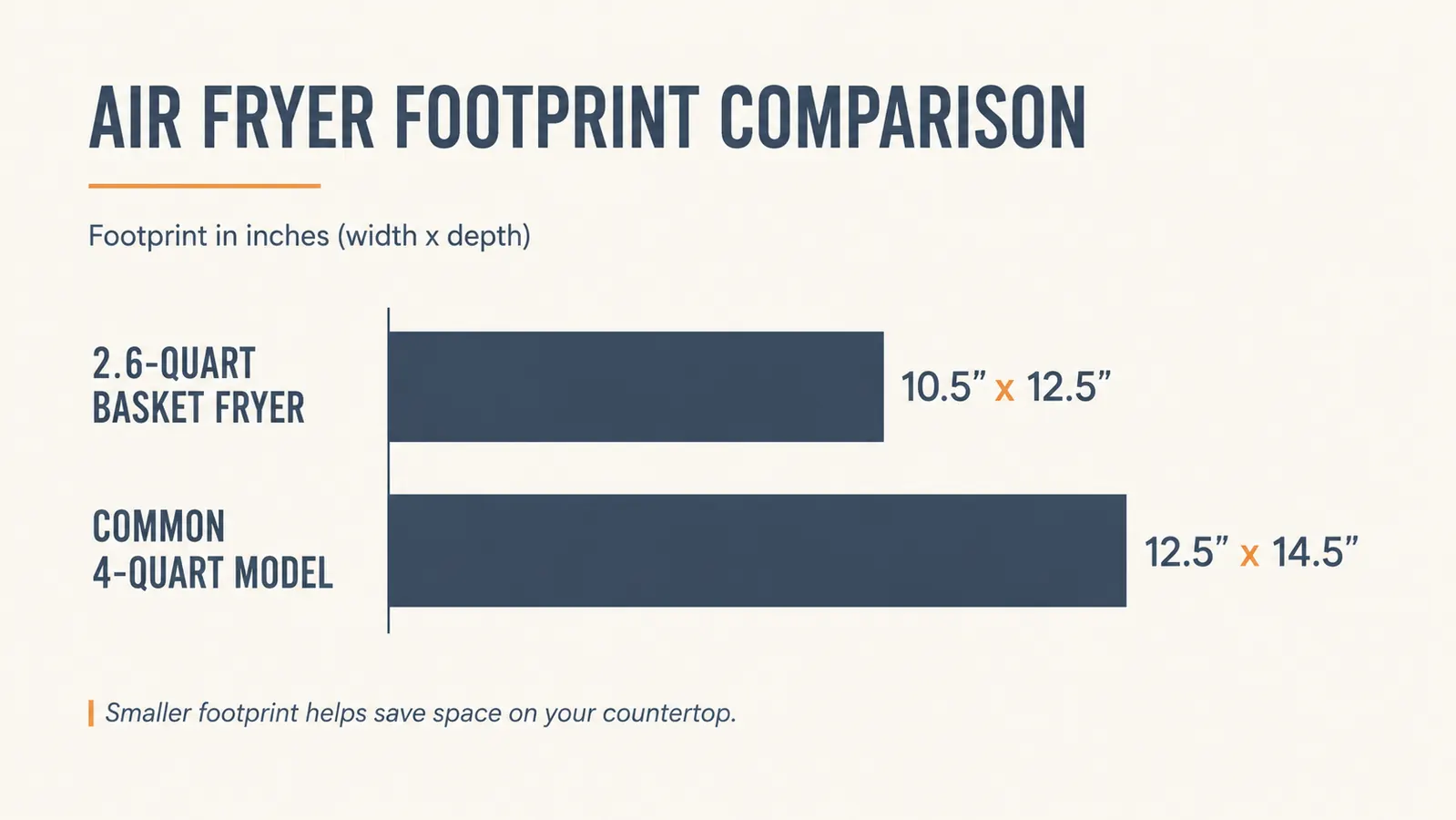
This is the part every review skips, so I'm going to be specific about it because it's the actual reason most people in small kitchens are reading this. The unit is roughly 8 inches wide, 11 inches deep, and just under 11 inches tall with the lid closed. It fits under my upper cabinets with about two inches to spare, so I never have to lift it down from a shelf before I use it, which is the single biggest reason it's still on my counter after six months instead of in a box in the hall closet.
I want to be honest that this measurement matters more than the quart capacity. A lot of small-kitchen shoppers fixate on quarts because that's the number Amazon puts in the title, but quarts tell you almost nothing about whether the thing will clear your cabinet or block your window. Measure your own space in inches before you buy anything, including this one.
For comparison, before this one I owned a 4-quart basket fryer that measured closer to 12 inches wide and 13 inches deep. It doesn't sound like a big jump on paper, but on an eleven-inch counter, the difference between a machine that fits and one that hangs two inches off the edge is the difference between using it every night and packing it away after a week. I learned that the expensive way.
Cooking Results Over Six Months
Fries come out genuinely crisp if I don't overcrowd the basket, which I learned the hard way the first two weeks by dumping in a full bag of frozen crinkle-cut and getting a soggy middle layer. Half a bag, shaken twice, comes out close to what I'd get from a much larger machine. Chicken thighs are reliably good, skin crisps up nicely at 380 degrees for about 22 minutes, and I've stopped needing to flip them halfway through because the basket shape circulates heat well enough on its own.
Where it struggles is anything that needs real surface area. Brussels sprouts cut in half, more than a cup and a half of them, start steaming instead of roasting because they're stacked instead of spread out. Same with a full batch of tater tots. If you're cooking for one and mostly doing proteins and a modest side, this isn't a problem you'll run into often. If you're feeding three or more people regularly, you'll be running it in batches, and that's worth knowing before you buy.
Reheating is where this thing has quietly become my most-used appliance. Leftover pizza in the microwave goes rubbery. In the DASH for four minutes at 350 degrees, the crust comes back close to fresh and the cheese doesn't turn to a puddle. Same with leftover fried rice and cold fries from takeout. I didn't buy this for reheating and it's turned into half of what I actually use it for.
Cleanup, After Real Use
The basket and pan are dishwasher safe, which I do about half the time. The other half I hand wash because my dishwasher is a countertop model that fits maybe four items at once, which is its own small-kitchen story for another day. Hand washing takes under two minutes. The nonstick coating was excellent for the first three months. Around month four I started noticing light scratching on the bottom of the basket, mostly from a metal spatula I shouldn't have been using, and food has started sticking slightly more than it did at the start. That's on me as much as the coating, but I'll flag it because it's a real change from month one.
There's no dedicated crumb tray, so anything that flakes off during cooking, breading, cheese, that sort of thing, ends up on the bottom of the basket pan. It wipes out easily but I do check it every couple uses, especially after breaded chicken tenders, or it starts to smoke a little on the next run.
One small habit that's saved me time: I keep a soft silicone brush next to the sink just for this basket, and I never use anything abrasive on it anymore. Since I started doing that in month five, the sticking has leveled off instead of getting worse. Worth mentioning if you're buying one of these expecting it to survive daily use with a metal scrubber, because it won't, not for long.
Noise and Counter Behavior
It's not silent. It runs at a steady hum that's noticeably louder than my microwave but quieter than my old box fan, and in a small apartment that sound carries into the living room about eight feet away. I've had to turn the TV up two notches during a cook cycle more than once. It doesn't vibrate or walk across the counter the way a couple of cheaper models I've tried in the past did, which matters when your counter space is also your prep space and you don't want something rattling toward the edge while you're chopping next to it.
Heat output is worth mentioning too, since counter space in a small kitchen usually means the appliance is close to a wall or a cabinet, not out in open air. The exterior gets warm but not alarming, and I've never worried about the wall behind it or the coffee maker six inches to its left. I did stop keeping my wooden cutting board leaned against the wall directly behind it after noticing a slight warmth transfer over a long cook cycle, more out of caution than any actual problem.
Who I've Considered Alongside It
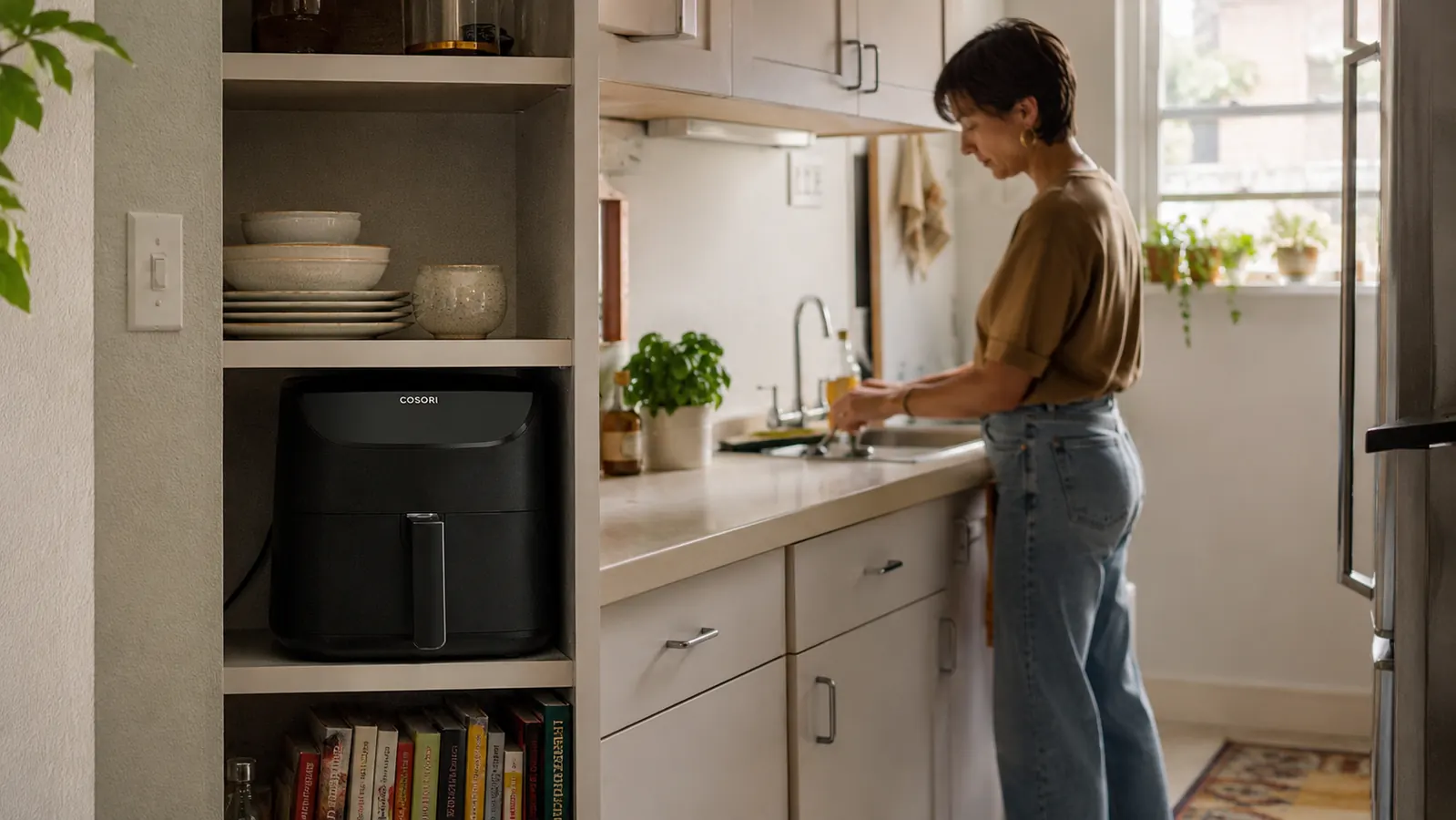
Before I settled on the DASH, I looked hard at a couple of larger basket-style fryers that promised more capacity. I ultimately passed because the width alone would have meant either giving up my coffee maker's spot or storing the fryer in a cabinet between uses, and appliances that live in cabinets don't get used in my kitchen. I've written up a direct comparison against one of the more popular larger models if you want the side-by-side on capacity, price, and footprint.
I also weighed whether an air fryer toaster oven combo would just replace two appliances at once and save me the counter argument entirely. It would, on paper. But those units run wider and taller than my cabinet clearance allows, and I'd be back to lifting something down from a shelf every night, which is exactly the habit I was trying to break when I got rid of the old toaster oven in the first place.
What I Liked
- Genuinely small footprint, 8 inches wide, fits under most upper cabinets
- Crisps fries and proteins well when the basket isn't overcrowded
- Quiet enough to run during a normal evening, doesn't walk on the counter
- Basket and pan are dishwasher safe, hand wash takes under two minutes
- Simple dial controls, no app, no menu to learn
- Reheats leftovers better than a microwave, genuinely useful bonus
Where It Falls Short
- 2.6 quarts is genuinely tight for two people eating the same meal
- No window to check food without pulling the basket
- Nonstick coating shows wear by month four with regular use
- No crumb tray, requires wiping the basket pan every few uses
- Runs loud enough to notice in an open-plan apartment
Quarts tell you almost nothing about whether the thing will clear your cabinet. Measure your own space in inches before you buy anything, including this one.
Who This Is For
This is the right air fryer if you're cooking for one or two people, you have a genuinely narrow counter run, and you want something you never have to lift down from a shelf to use. It's also a good fit if you're replacing a toaster oven or a larger air fryer that's been quietly living in a cabinet because it never fit the counter in the first place. If your daily cook is a protein and a side, not a full spread, the size stops being a limitation and starts being the whole point.
Who Should Skip It
If you're cooking for three or more people most nights, or you regularly want a full tray of vegetables alongside a protein in one run, the 2.6-quart basket will frustrate you. You'll be doing two or three batches for a single meal, and at that point a larger basket-style fryer or an air fryer toaster oven combo will save you more time than the smaller footprint saves you counter space. It's also not the fryer for anyone who wants a viewing window or a touchscreen with cook presets. This is a dial, a basket, and a timer.
If your counter is as tight as mine, this is worth a look.
See current pricing, availability, and customer photos on Amazon.
Amazon Check Today's Price on Amazon →