
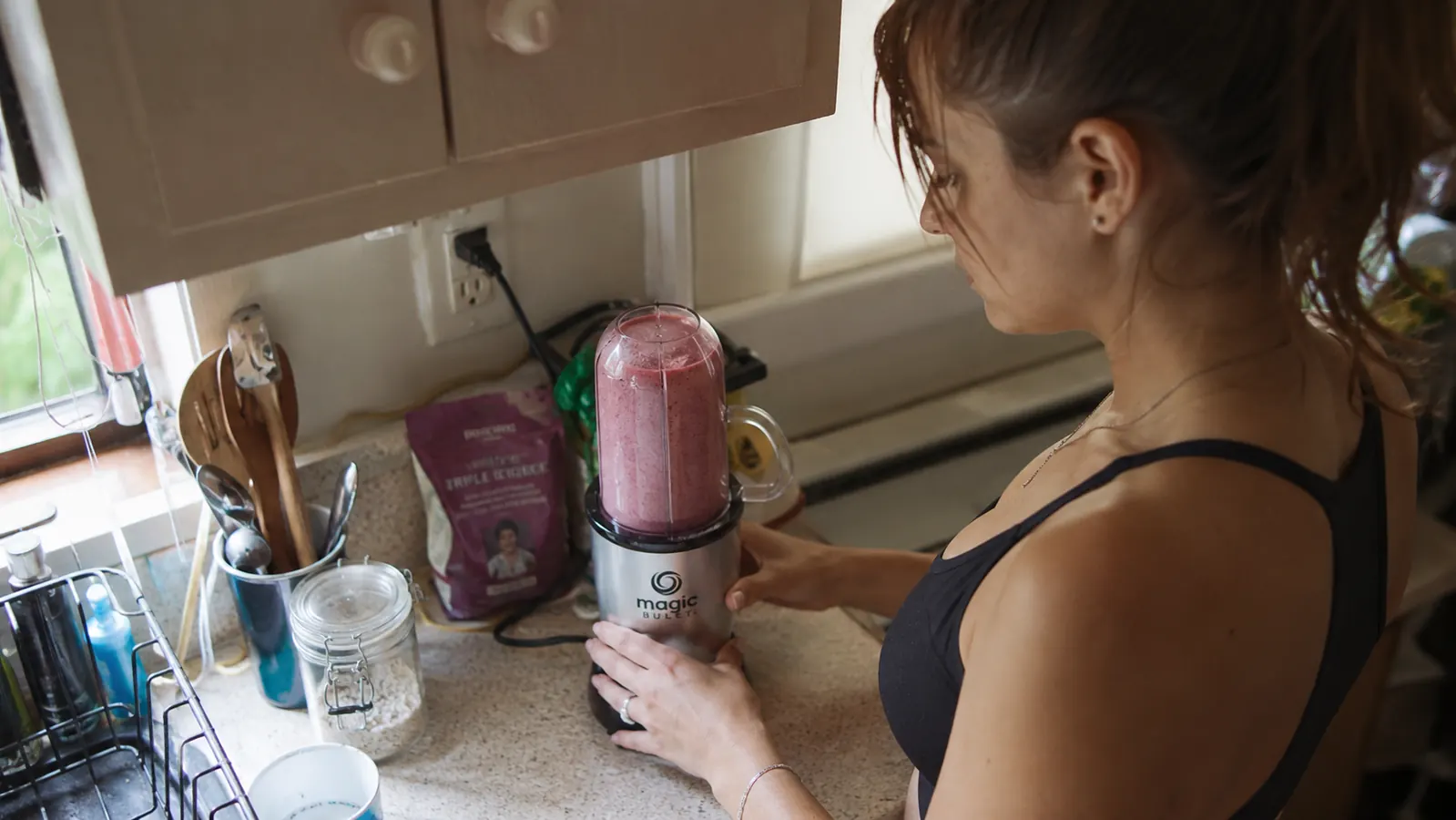
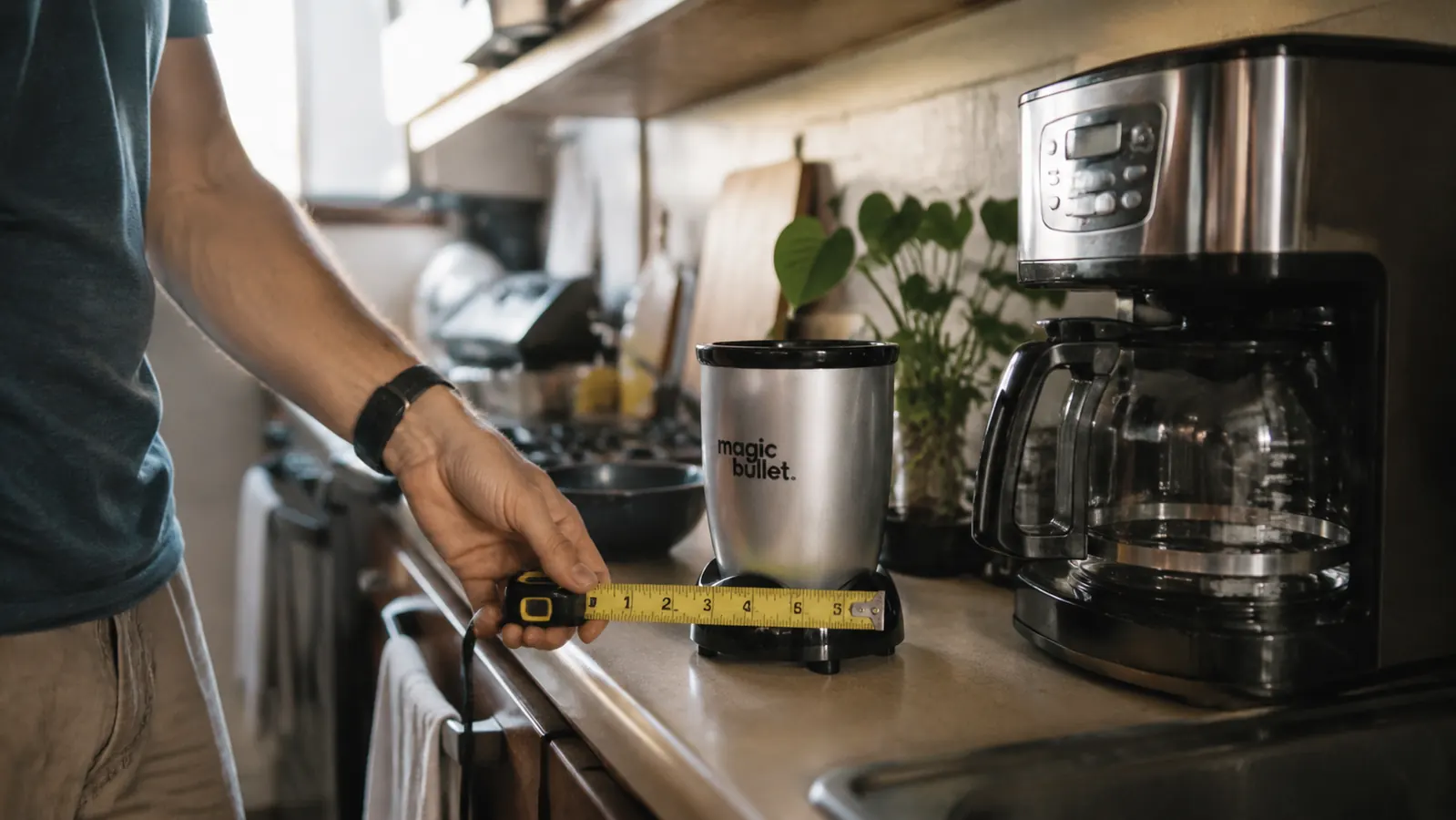
My counter is thirty inches of laminate between the sink and the stove, and a full-size blender never earned a permanent spot on it. It was too wide to leave out and too heavy to lift down from the shelf above the fridge every morning, so it sat in a cupboard and I stopped making smoothies at all for about a year. The Magic Bullet changed that mostly because of what it doesn't do. It doesn't take up more than a coffee maker's footprint, it doesn't have a pitcher to wash, and it doesn't ask me to commit counter space I don't have.
What the Magic Bullet does ask for is a different technique than a full-size blender, and nobody tells you that when you buy one. A personal blender cup is small, the blade is close to the bottom, and if you load it the way you'd load a pitcher blender, you'll end up with a stalled motor, a green smear at the bottom, and frozen chunks floating on top untouched. This is the exact loading order, portion line, and pulse pattern I've landed on after making a smoothie in mine most weekday mornings for the better part of a year. If your kitchen has the same thirty inches of counter mine does, this is written for that kitchen.
The blender this whole method is built for
Everything below assumes the Magic Bullet's tall 18-ounce cup and the standard cross blade that comes in the 11-piece set. If you're shopping for one, check today's price before you start loading fruit, it's genuinely the smallest blender I've used that still finishes a smoothie in one pass.
Amazon Check Today's Price on Amazon →Step 1: Load liquid first, every time, no exceptions
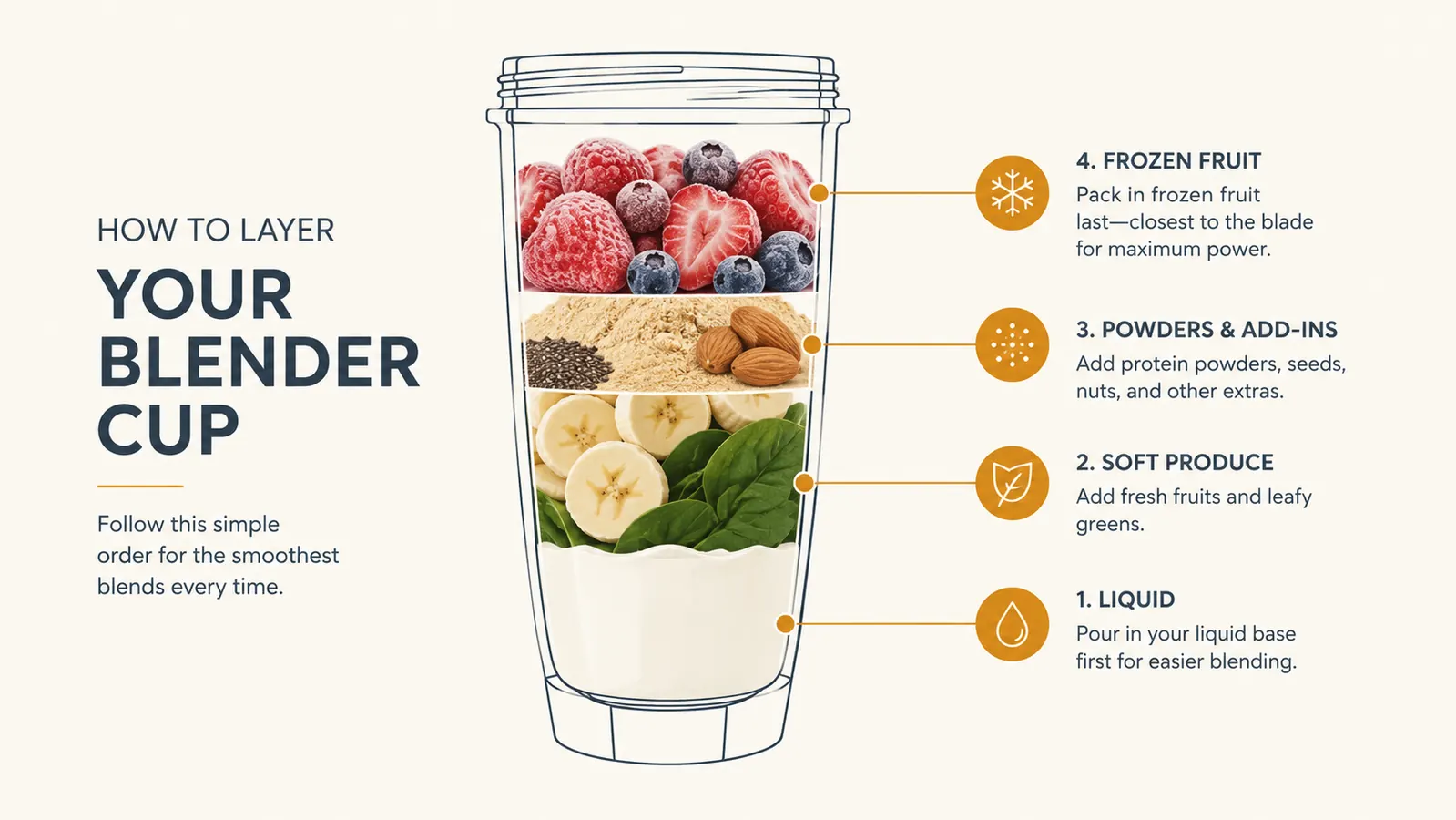
I pour about half a cup of liquid into the bottom of the tall cup before anything else goes in. That's almond milk most mornings, sometimes plain water or orange juice depending on what I'm making. This is the step people skip when they're used to a full-size blender pitcher, where the blade sits low enough that dry ingredients on the bottom still get pulled into the vortex. In a Magic Bullet cup, the blade is close to the bottom and there's almost no vortex to speak of. Without liquid underneath, the blade just spins in place against solid fruit and nothing moves.
I learned this the hard way the first week I owned mine, dumping frozen mango straight in and wondering why the motor whined instead of blending. Liquid first gives the blade something to grab and push everything else down into. It sounds like a small detail, but it's the single biggest difference between a smoothie that finishes in fifteen seconds and one that needs to be stopped, stirred with a butter knife, and started three more times.
How much liquid depends on how thick I want the finished smoothie. Half a cup gets me something I can eat with a spoon, closer to soft-serve than a drink. If I want something I can actually sip through the lip ring lid on the way out the door, I'll go closer to three-quarters of a cup. I adjust that number more than any other part of the process, and it's the easiest variable to change without throwing off the rest of the loading order.
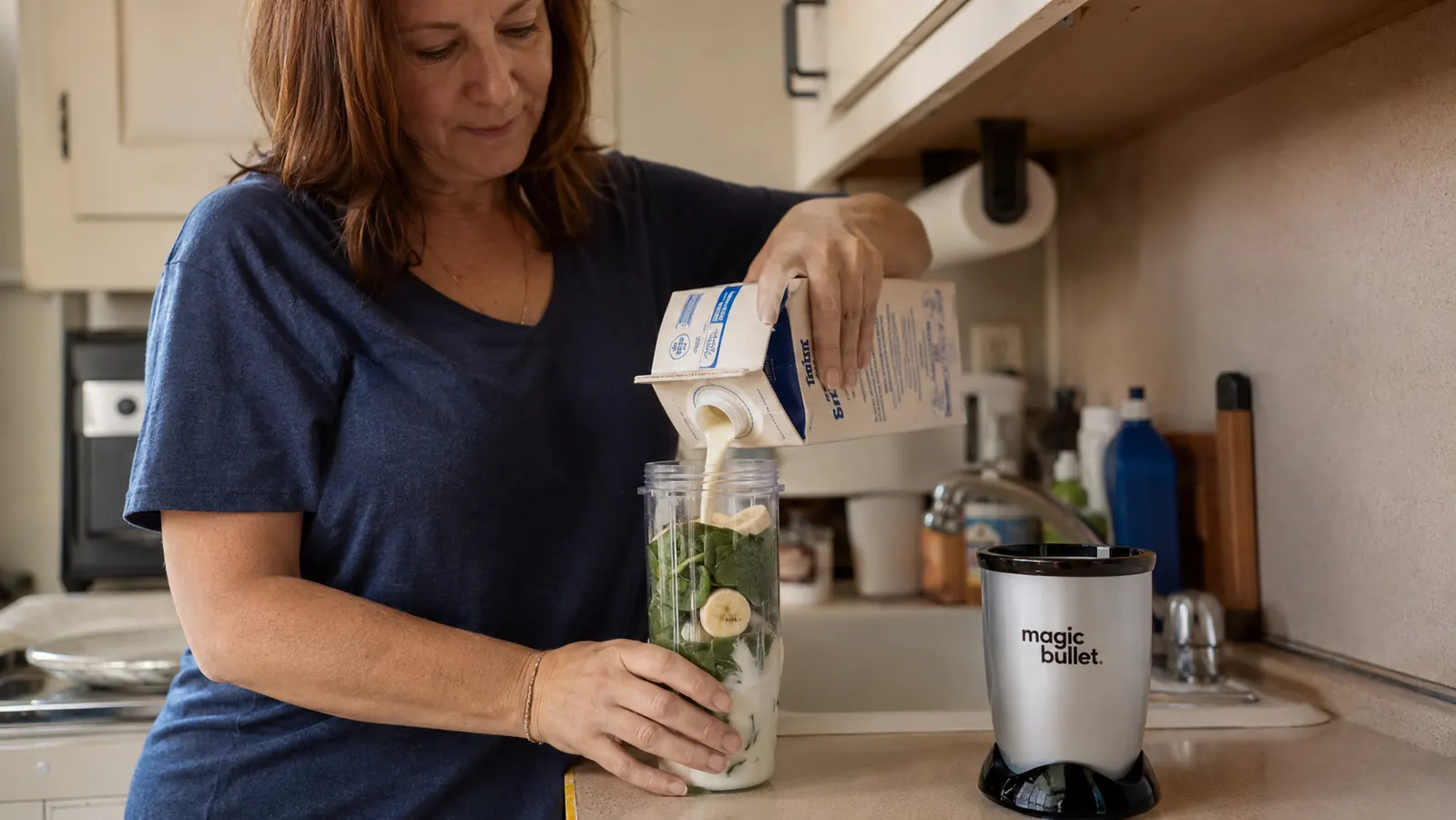
Step 2: Stack soft ingredients next, keep frozen fruit for last, and stop at the fill line
After the liquid, I add anything soft. Half a banana, a handful of spinach, a spoonful of peanut butter, whatever's going in that day. Soft ingredients settle into the liquid and start breaking down almost instantly once the blade turns, so they do most of the early work of building the smoothie's base. Powders come next if I'm using them, a scoop of protein powder or a spoonful of ground flax, added before the frozen fruit so they don't clump on top and blow out through the vent when the blade first spins.
Frozen fruit goes in last, piled on top rather than mixed in. That's counterintuitive if you're used to just dumping everything in a pitcher at once, but in a cup this size, frozen chunks on top get pulled down into the moving liquid instead of sitting directly against a stalled blade. I use about a cup of frozen strawberries or mango, and I stop filling well below the cup's printed fill line, usually with an inch of headroom. The tall cup holds eighteen ounces total, and I've learned that filling it to the line with solid ingredients leaves no room for anything to actually move once the blade starts.
The order matters more than the exact ratio. I've swapped fruits, greens, and add-ins constantly over the past year, but liquid on the bottom and frozen fruit on top has never once failed me, no matter what's in between. If I'm ever unsure whether something counts as soft or frozen, like a partially thawed peach, I treat it as frozen and load it last. It's a safer default than guessing wrong and burying it under everything else.
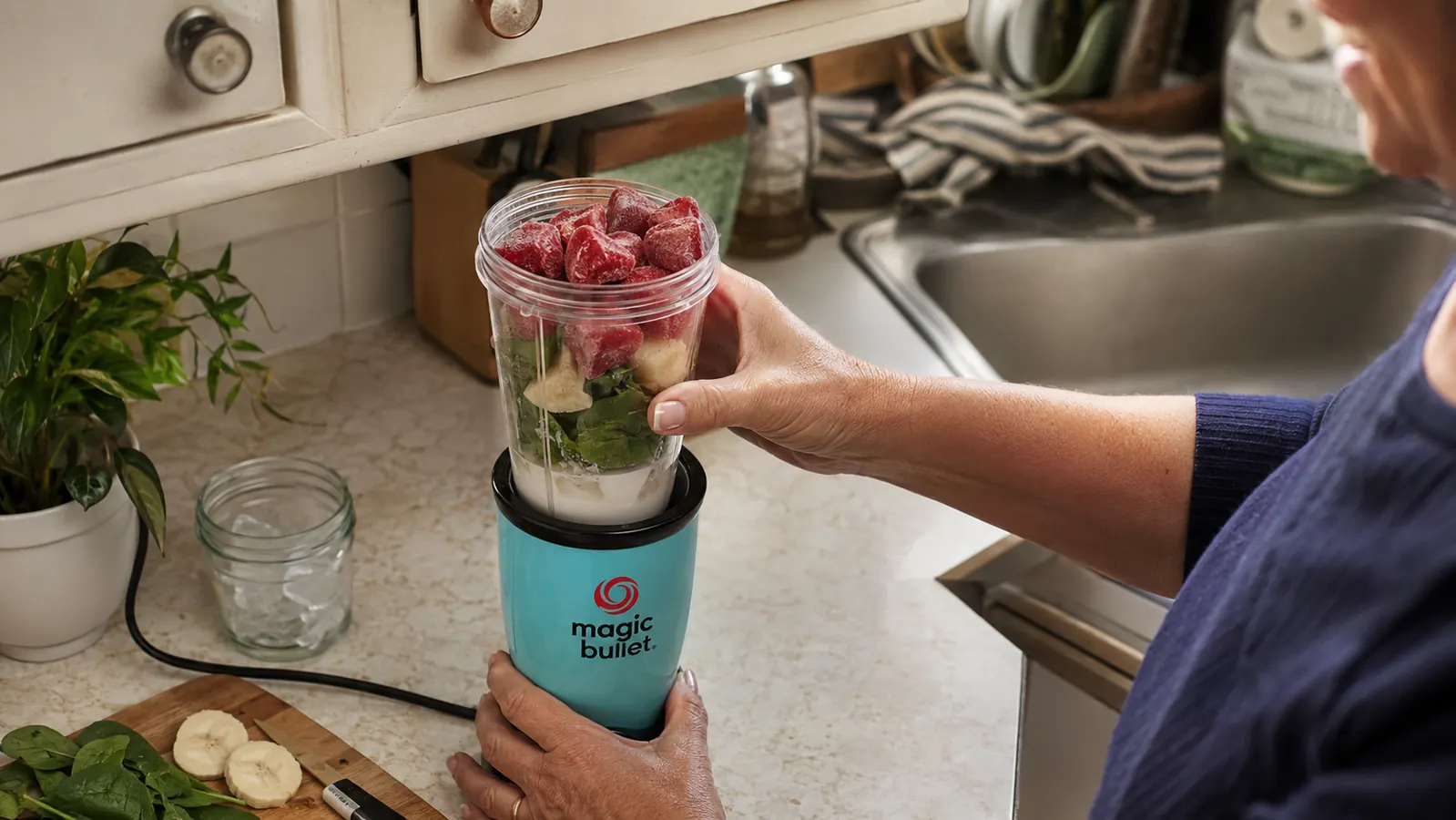
Step 3: Twist the base on tight, then run it in short pulses instead of one long hold
The cup twists onto the base and locks with a quarter turn, and I always check that it's seated all the way before I flip it over. A cup that isn't fully twisted on will leak from the seal the moment liquid hits the blade, which I found out over my own socks one morning in a hurry. Once it's locked and flipped upside down onto the base, I run it in short pulses, three or four seconds on, a pause, three or four seconds on again, rather than holding it down for fifteen straight seconds.
Short pulses let the ingredients settle back down between bursts instead of getting stuck spinning in one place above the blade, which is what happens when frozen fruit forms an air pocket during one long continuous run. If I hear the pitch of the motor change to a higher, thinner whine, that's my signal something's caught above the blade and not actually being cut, and I stop rather than let the motor keep working against it. Between pulses, I'll sometimes give the whole cup a quick shake against the counter, still locked to the base, just to knock anything stuck against the wall back down toward the blade.
Step 4: If it stalls, don't force it, add a splash of liquid and shake
Every personal blender stalls occasionally, no matter how carefully you load it, and the Magic Bullet is no exception. When mine does, I don't hold the motor down and hope it powers through, since that's the fastest way to burn out a small motor that isn't built for that kind of sustained resistance. Instead I lift the cup off the base, add a small splash more liquid, twist the flat lid on, and give the whole cup a firm shake to redistribute everything before locking it back onto the base.
This fixes probably nine out of ten stalls for me. The tenth one is usually too much frozen fruit relative to liquid, and the honest fix is dumping a little out rather than fighting it. I keep a small measuring cup by the blender now specifically so I'm not eyeballing the frozen fruit portion and overloading it out of habit, since that's the mistake I make most often when I'm not paying attention.
One thing I stopped doing entirely is running the blender for longer than about thirty seconds total, pulses included. If it's not smooth by then, more blending time isn't the fix, more liquid is. A smoothie that's still chunky at thirty seconds usually just needs another splash, not another minute of the motor working against itself. I also stopped using ice cubes altogether. Frozen fruit does the same chilling job and doesn't dull the blade the way ice does over time, which I noticed after about four months of daily use.
Step 5: Unlock the cup, swap the flat lid for the lip ring, and drink from the same cup you blended in
Once it's smooth, I twist the cup off the base, wipe the rim, and swap the flat sealing lid for the lip ring lid that came in the eleven-piece set. That's the part of this whole system that actually earned it a permanent spot on my counter. There's no pouring the smoothie into a separate glass and washing a pitcher, a lid, and a glass every morning. I blend in the cup, drink from the cup, and rinse one piece.
The base itself gets wiped down, not submerged, since the motor housing isn't meant to get wet. The cup, blade, and whatever lid I used go in the sink or the top rack of the dishwasher. Most mornings the whole process, load, blend, drink, rinse, takes less time than it would have taken to stand in line for one at a coffee shop, which is the actual reason I still make one most weekdays instead of skipping breakfast.
What Else Helps
Pre-portioning frozen fruit into small bags or containers on a Sunday cuts my weekday prep down to almost nothing, since the only decision left in the morning is which liquid to pour. I keep a set of the short party mug cups from the same set in the freezer with pre-measured spinach and fruit already loaded, so some mornings I'm just adding liquid and locking the base on. It's a small habit, but it's the difference between making a smoothie most days and making one only on days I feel motivated.
If you're blending greens regularly, chop them roughly before they go in rather than adding whole leaves. Whole spinach leaves can wrap around the blade instead of getting cut by it, especially in a blender this size where there's less room for the leaves to move independently. A rough chop with kitchen scissors, right into the cup, takes ten seconds and saves a stalled blend.
I also keep the blade assembly separate from the cups when I store them, rather than leaving a blade twisted onto a cup in the cupboard. It dries faster that way and I've never nicked a knuckle reaching for a cup blind, which happened twice before I started doing this. None of this is complicated. It's mostly about respecting how small the cup actually is instead of treating it like a shrunk-down version of a full-size blender that happens to fit in less space.
One last habit worth mentioning: I run a quick rinse cycle right after I drink, not an hour later. A cup with dried smoothie residue in the threads gets harder to twist onto the base cleanly, and I've had a lid seal poorly because of dried fruit stuck in the gasket. Thirty seconds under warm water while the cup is still fresh saves a bigger scrub-down later, and it's the one small chore that keeps this whole routine as fast as it's supposed to be.
Liquid on the bottom, frozen fruit on top, short pulses instead of one long hold. That order has never once failed me in a cup this small.
If your counter is as short on room as mine, this is the blender to check
It's the one appliance in my kitchen that goes back on the counter every single morning instead of into a cupboard. See today's price and current availability before you plan tomorrow's breakfast.
Amazon Check Today's Price on Amazon →